
Reduce First: Envelope, Ventilation & Low-Temperature Hydronic Upgrades for Ontario Buildings

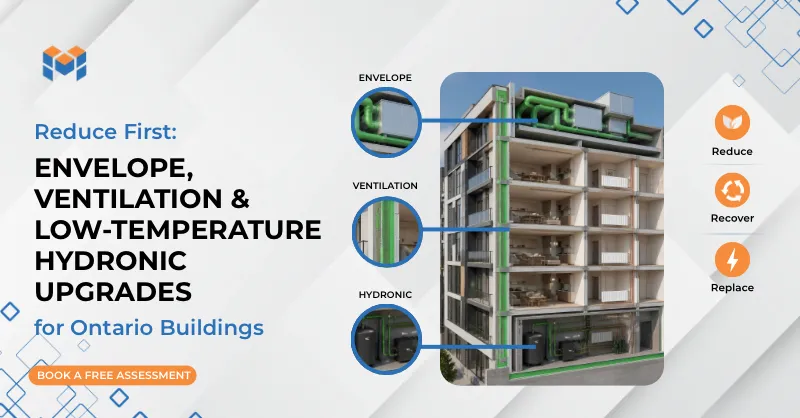
This is the first phase of Mann Engineering’s phased decarbonization roadmap (see the pillar post: Building Decarbonization in Ontario). Before any building electrifies its heating plant, the smartest move is to reduce building energy load — because every kilowatt you design out is a kilowatt of heat-pump capacity you never have to buy, install, or power.
Why Reducing Load Comes First
Electrifying a building before you reduce building energy load locks you into oversized, more expensive heat-pump equipment sized to a wasteful baseline. Reduce first, and the whole downstream project gets smaller and cheaper: lower peak demand, smaller electrical service upgrades, and heat pumps sized to what the building actually needs. In Ontario’s cold climate, load reduction also improves tenant comfort during the coldest weeks — exactly when older buildings struggle.
Building Envelope Improvements
Much of the load in a 1960s–1990s Ontario tower leaks straight through the envelope. Roof and wall insulation, window replacement or upgrades, and air-sealing cut heating demand and draughts. Envelope work is often best timed with planned facade or window capital work — doing it together avoids paying for scaffolding and mobilization twice, and it’s a core way to reduce building energy load before electrification.
Ventilation & Controls Optimization
Fresh air is essential to healthy buildings, but constant-volume ventilation running full-tilt around the clock wastes enormous energy. Optimizing ventilation — demand-based control, a dedicated outdoor air system (DOAS) approach, and recovering heat from exhaust air — keeps indoor air quality while cutting waste. Pairing this with building automation (BAS) scheduling and outdoor-air reset is one of the fastest ways to reduce building energy load with little or no equipment replacement.
Lower-Temperature Hydronic Distribution
This is the quiet enabler of the whole decarbonization plan. Older buildings distribute heat with high-temperature water (or steam) — temperatures that heat pumps can’t efficiently produce. Shifting the building toward lower-temperature hydronic distribution — and replacing terminal units with fan coils, radiant panels or similar low-temperature devices — both reduces distribution losses now and makes the building “heat-pump ready” for later. As the decarbonization playbook puts it: steam is out, water is in.
Two upgrades that consistently pay back here:
VFDs on pumps and fans — let motors run at the speed the building needs instead of full speed continuously, cutting electricity with a short payback.
Dual-temperature 2-pipe hydronic conversions — enable simultaneous heating and cooling on a single low-temperature loop, the backbone of an electrified tower.
Where Reduce Leads Next
Once you’ve reduced the load, the next phase is recovering the heat the building still wastes (Blog: Stop Sending Heat Down the Drain). Together, Reduce and Recover shrink the eventual heat-pump plant dramatically. A free building retrofit assessment from Mann Engineering identifies which envelope, ventilation and hydronic measures will reduce building energy load most in your specific building — and which Ontario incentives can offset them. Contact Mann Engineering to get started.

Comments